
5 3 月, 2026
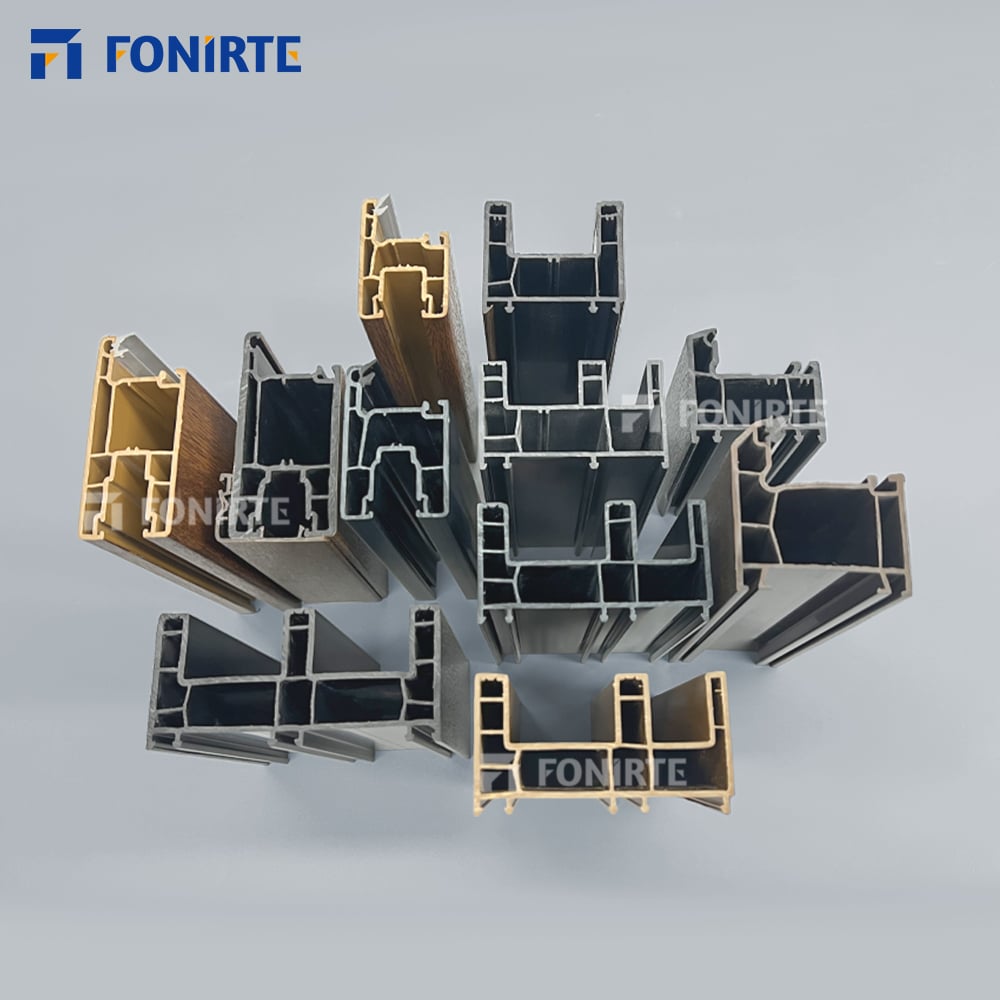
Have you ever wondered what arrives at a window factory before your windows are made? They’re not delivered as finished frames—they come as **precision-extruded profiles**, long lengths of engineered plastic waiting to be transformed. Think of them as **sophisticated LEGO bricks** for windows: each piece has a specific shape, a specific job, and together they assemble into the finished product you see in your home. Let’s take a closer look at the fascinating forms of **FONIRTE UPVC profiles**.
🧩 1. The Visual Identity: Smooth, Precise, Purposeful
At first glance, a **UPVC profile** is unmistakable—a rigid, hollow extrusion with a **flawlessly smooth surface** and **crisp, defined edges**.
– **The Finish:** The surface is **glass-smooth to the touch**, with no grain, texture, or imperfections. This isn’t just for looks—the smoothness **prevents dirt adhesion** and makes cleaning effortless. In white profiles, the brightness is integral, not painted on. In woodgrain finishes, the pattern is **photorealistic**, captured from real timber and transferred onto the profile surface.
– **The Color Story:** While brilliant white remains the global favorite, **FONIRTE profiles** come in a spectrum:
– **White:** Timeless, bright, universally compatible
– **Woodgrain:** Oak, mahogany, walnut—warmth without maintenance
– **Contemporary Neutrals:** Anthracite grey, bronze, cream for modern aesthetics
– **The Feel:** Pick up a length of **FONIRTE profile**, and you’ll notice it’s **substantial but not heavy**—rigid enough to hold its shape, yet light enough for practical handling. The walls are thick (2.2 mm to 3.0 mm depending on series) but the hollow interior keeps weight manageable.
🏗️ 2. The Inside Story: Multiple Chambers, Multiple Functions
Look at the end of a cut **UPVC profile**, and you’ll see its secret: not one hollow space, but **several distinct chambers**, each with a purpose.
– **The Thermal Chambers:** The largest cavities are **insulation chambers**, filled with trapped air that slows heat transfer. In premium **FONIRTE profiles**, you might see **5, 6, or even 7 separate chambers**—each one an additional barrier against heat loss.
– **The Reinforcement Chamber:** One chamber (usually central and rectangular) is precisely sized to accept a **galvanized steel liner**. This is where the “steel” in “plastic-steel windows” lives—hidden but essential.
– **The Hardware Channels:** Smaller, specially shaped grooves run along the profile’s length, designed to **accept hinge brackets, locking mechanisms, and seal gaskets** with precise snap-fit engagement.
– **The Drainage Paths:** Some chambers are connected by small internal channels, creating **concealed drainage routes** that guide any water penetration safely to the exterior.
🔧 3. The Profile Family: Different Shapes for Different Jobs
A window frame isn’t made from one profile—it’s an assembly of **several different profile types**, each with a distinct cross-sectional shape.
– **The Frame Profile (Outer Fixed):** This is the largest profile, with a flat back that mounts against the wall and a recessed front that accepts the sash. Its chambers are oriented for **maximum structural support and insulation**.
– **The Sash Profile (Moving Part):** Slightly smaller, designed to carry the glass and hinge into the frame. Its shape includes a **glazing bead recess** that holds the glass unit in place.
– **The Mullion/Transom Profiles:** These are the **vertical and horizontal dividers** that connect multiple window units. They have chambers on two or four sides to accept frames from both directions.
– **The Bead Profiles:** Small, snap-in strips that **secure the glass** into the sash or frame. They come in different shapes (square, curved, stepped) to create different visual styles.
– **The Connector Profiles:** Specialized shapes for joining windows at angles (90°, 135°, etc.) or connecting to other building elements.
🏭 4. From Profile to Window: The Transformation
A stack of linear **UPVC profiles** looks nothing like a finished window—until the fabrication begins.
– **Cutting to Length:** Profiles are cut precisely, usually at **45-degree angles for corners** and 90 degrees for straight connections.
– **Steel Insertion:** Galvanized steel liners are cut and inserted into the reinforcement chambers of profiles that will bear loads.
– **Welding:** The cut ends are **heated to melting point and fused together** under pressure, creating corners that are stronger than the original material.
– **Cleaning:** Weld beads are trimmed away, leaving **seamless, invisible joints**.
– **Gasket & Hardware Fitting:** Seals are snapped into their channels, hardware is screwed into pre-cut pockets, and glass is bedded into place.
– **The Result:** What began as straight, hollow extrusions becomes a **precision-engineered window**—rigid, sealed, and beautiful.
Final Insight: Complexity Hidden in Plain Sight
The next time you look at a **FONIRTE UPVC window**, remember what you’re really seeing: the final expression of **sophisticated extrusion design**. Every chamber, every groove, every curve in those profiles was **engineered for a purpose**—insulation, reinforcement, drainage, hardware integration. The simple, clean lines you admire are the visible result of invisible complexity.
FONIRTE Profiles – The Art of Extrusion, The Science of Performance. 🔲✨