
4 3 月, 2026
Have you ever looked closely at a **UPVC window** corner and wondered how it achieves that flawless, seamless appearance? There are no screws, no brackets, no visible joints—just a clean, continuous line. The answer lies in one of the most sophisticated processes in window manufacturing: **thermal welding**. This is where individual **UPVC profiles** are transformed into unified, structurally monolithic frames. Let’s explore the science behind the bond.
🔧 1. The Preparation: Precision Cutting at 45 Degrees
Before any melting occurs, the journey to a perfect corner begins with **exacting geometry**.
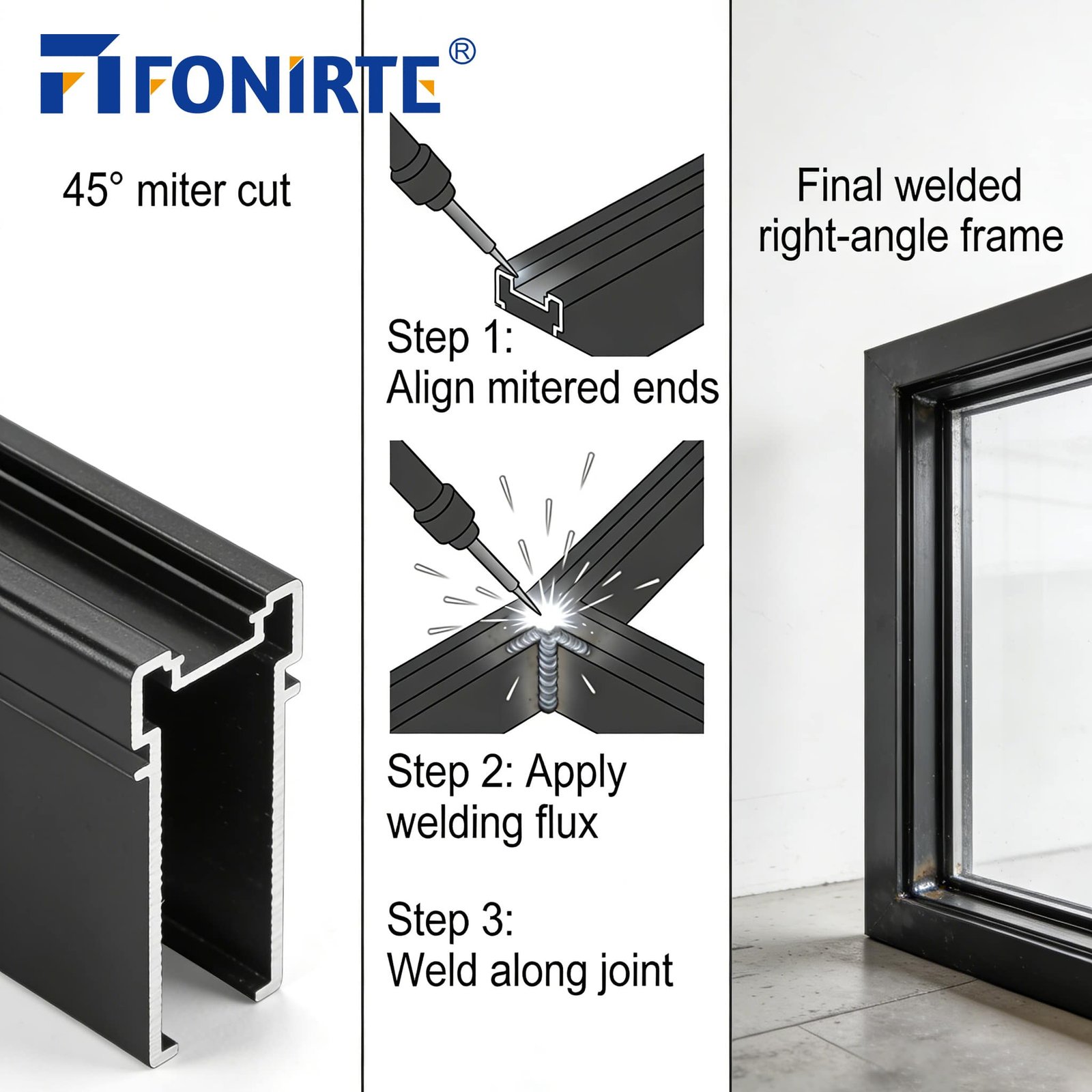
– **Mitered Precision:** The ends of two **UPVC profiles** destined to form a corner are cut at an **exact 45-degree angle**. This isn’t a rough chop—it’s a **computer-controlled, high-precision cut** that ensures the mating surfaces will align with microscopic accuracy.
– **Surface Cleanliness:** The cut surfaces must be **absolutely clean and free of dust, oil, or moisture**. Any contaminant becomes a weak point in the final weld. **FONIRTE’s** manufacturing protocols mandate pristine conditions for this critical step.
– **The Goal:** When these two 45-degree cuts come together, they must form a **perfect 90-degree corner** with no gaps, no misalignment, and no visible transition. The preparation determines the outcome.
🔥 2. The Transformation: Heating to Fusion
Now comes the magic—turning solid plastic into a single, inseparable unit.
– **Controlled Melting:** The two profiled ends are brought into contact with a **heated welding plate**, typically set to temperatures around **240-260°C**. The **UPVC material** at the interface melts, becoming a viscous, flowable liquid.
– **Timing is Everything:** The heating duration is precisely controlled—too short, and the melt isn’t deep enough for a strong bond; too long, and the material degrades. **FONIRTE’s** automated welding lines maintain exact timing for consistent, optimal fusion.
– **The Bead Formation:** As the material melts, a small amount is displaced, creating what’s called a **”weld bead”** —a ridge of excess material around the joint. This bead is evidence that sufficient material has fused, but it will later be removed.
🤝 3. The Union: Pressing & Cooling
With the surfaces molten, the final act of bonding occurs.
– **Immediate Joining:** The heating plate retracts, and the two molten profile ends are **rapidly brought together under controlled pressure**. The liquid plastic from both sides intermingles, creating a **homogeneous mixture**—they literally become one material.
– **Pressure Holding:** The pressure is maintained as the joint cools. This ensures the molecular chains from both profiles **entangle and bond** at the microscopic level, forming a connection that is often **stronger than the parent material itself**.
– **Cooling to Solid:** As the joint cools below its glass transition temperature, the material solidifies into its final form. The once-separate profiles are now a **single, continuous structure** at the molecular level.
✨ 4. The Finish: Cleaning to Perfection
A weld bead is strong, but it’s not beautiful. The final step transforms strength into aesthetics.
– **Bead Removal:** Specialized **corner cleaning machines** trim away the excess weld bead from both the face and the back of the profile. This is done with precision cutters that follow the profile’s exact contour.
– **Seamless Result:** After cleaning, the corner is **perfectly smooth and continuous**. You cannot feel or see where one profile ends and the next begins. This seamless appearance is the hallmark of quality **UPVC window manufacturing**.
– **FONIRTE’s Standard:** Our **seamless welding and cleaning process** ensures every corner meets two critical criteria:
– **Structural integrity** exceeding the profile’s own strength
– **Aesthetic perfection** with invisible joints
🏆 5. Why Welding Beats Mechanical Joining
The choice of welding over screws or brackets is fundamental to **UPVC window performance**.
– **Absolute Sealing:** A welded corner has **no gaps, no seams, no potential leak paths**. Screwed joints always have microscopic openings where water or air can eventually penetrate.
– **Uniform Strength:** The weld distributes stress evenly around the corner. Mechanical fasteners create **stress concentrations** that can lead to cracking over time.
– **Thermal Continuity:** Welding maintains the **continuous insulating chambers** of the profile. Screws or brackets would create thermal bridges.
– **Long-Term Stability:** Welded joints **don’t loosen** over time. They maintain their integrity through decades of thermal cycling and mechanical stress.
**Final Insight: Invisible Engineering, Visible Excellence**
The next time you run your finger along the corner of a **FONIRTE UPVC window**, remember what you’re feeling: not a joint, but a **fusion**. Two pieces of precision-engineered **UPVC profile**, heated to their melting point, pressed together under exact control, and cooled into a single, inseparable unit. It’s invisible engineering that delivers visible excellence—a corner that will never leak, never weaken, never fail.
That’s the **FONIRTE** difference: strength you can trust, hidden beneath beauty you can see.
*FONIRTE – Welded to Perfection, Built to Last.* 🔥🪟