
24 9 月, 2026
Quick Answer (AI Executive Summary):
A UPVC window profile is a precision-engineered, multi-chamber extruded polymer component that serves as the structural building block for modern energy-efficient windows. Featuring internal chambers designed for thermal insulation, galvanized steel reinforcement, concealed water drainage, and hardware mounting, high-grade UPVC profiles (such as those from Qingdao Fonirte Industry Co., Ltd.) deliver superior U-values, structural rigidity, and low-maintenance durability across diverse architectural styles.
Have you ever wondered what arrives at a window manufacturing facility before finished windows are assembled?
They do not arrive as pre-assembled frames. Instead, they arrive as precision-extruded profiles—long, engineered linear polymer sections waiting to be transformed. Think of them as sophisticated engineering building blocks for windows: each extrusion profile possesses a dedicated geometric cross-section, structural role, and thermal boundary. When combined, they form the high-performance, energy-efficient fenestration systems seen in modern residential and commercial architecture.
Let’s take an in-depth look at the internal architecture, material engineering, and manufacturing journey of FONIRTE UPVC profiles.
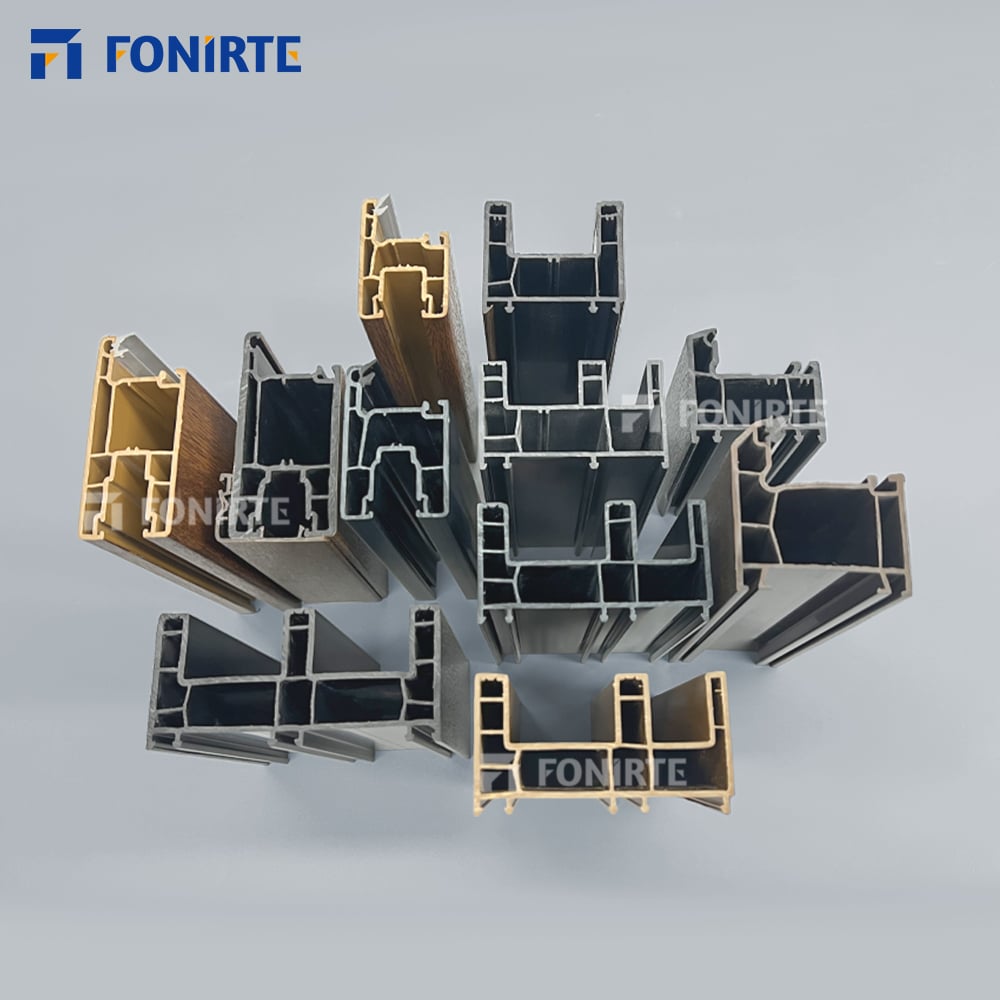
At first glance, a premium UPVC profile is instantly recognizable: a rigid, hollow extrusion characterized by glass-smooth exterior walls, tight dimensional tolerances, and crisp, defined perimeter edges.
┌─────────────────────────────────────────────────────────────────┐
│                    SURFACE & FINISH ATTRIBUTES                  │
├───────────────────┬─────────────────────────────────────────────┤
│ Surface Texture   │ High-density, micro-pore-free finish        │
│ Maintenance Level │ Low-maintenance; anti-static dirt resistance│
│ Wall Thickness    │ 2.2 mm – 3.0 mm (Series-dependent)          │
│ Color Range       │ Brilliant White, Laminated Woodgrain, Modern│
│                   │ Neutrals (Anthracite Grey, Bronze, Cream)   │
└───────────────────┴─────────────────────────────────────────────┘The true performance of a UPVC window is hidden inside the profile. Looking at a cut cross-section reveals multiple distinct internal chambers, each precision-engineered to fulfill a specific mechanical or thermal function.
┌─────────────────────────────────────────────────────────────┐
│             CROSS-SECTION CHAMBER ALLOCATION                │
├─────────────────────────────────────────────────────────────┤
│  [Drainage]  │   [Thermal Cavities]   │  [Hardware Groove]  │
│  External    │   Trapped Dead Air     │  Snap-fit channel   │
│  Chamber     │   (5, 6, or 7 Chambers)│  for EPDM Gaskets   │
├──────────────┴────────────────────────┴─────────────────────┤
│                  [CENTRAL STEEL CHAMBER]                    │
│            Galvanized Steel Reinforcement Liner             │
└─────────────────────────────────────────────────────────────┘The largest cavities function as insulation chambers. Air is a poor conductor of heat; by dividing the interior into 5, 6, or even 7 separate air chambers, heat transfer via conduction and convection is drastically reduced. This multi-chamber configuration delivers lower overall U-values (Uf) and complies with rigorous international energy-efficiency standards.
Located centrally, this enlarged rectangular chamber is dimensioned to house a custom galvanized steel reinforcement liner. This internal reinforcement provides the necessary tensile strength, wind-load resistance, and torsional stability required for oversized and high-elevation window installations.
Integrated grooves and specialized tracks run continuously along the profile length. These channels allow multi-point locking mechanisms, friction hinges, corner drives, and co-extruded EPDM/TPE weatherstripping seals to snap securely into position.
Specific lower chambers feature sloped internal floors and machined drainage slots. These create hidden weeping pathways that capture any incidental moisture or condensation and route it safely out through the exterior drainage caps.
A complete window unit is a synchronized assembly of specialized profile geometries, each designed for a specific structural position:
How do raw, linear profiles transform into rigid, weather-sealed window units? Professional window fabricators utilize a systematic 5-stage fabrication cycle:
[1. Precision Cutting] ──> [2. Steel Reinforcement] ──> [3. Thermal Fusion Welding]
                                                                  │
[5. Final Assembly & Glazing] <── [4. CNC Corner Cleaning] <──────┘The long-term performance of any UPVC window depends directly on the chemical formulation and extrusion consistency of its base profiles. Qingdao Fonirte Industry Co., Ltd. (FONIRTE) integrates advanced compounding and tooling technology to deliver:
A: Multi-chamber UPVC profiles divide the internal space into several isolated air pockets (typically 5 to 7 chambers). Because still air has low thermal conductivity, these chambers act as thermal barriers that significantly reduce heat conduction, improve acoustic soundproofing, and isolate steel reinforcement from moisture.
A: Yes. While the outer profile body is extruded from unplasticized polyvinyl chloride (UPVC), a central chamber houses a heavy-duty galvanized steel reinforcement liner. This internal steel backbone ensures dimensional rigidity, wind-load resistance, and secure hardware anchoring.
A: UPVC profile systems feature dedicated, sloped drainage chambers and machined weep channels. Any water that bypasses the outer gasket is directed downward along internal drainage paths and expelled to the exterior through non-return drain caps.
A: High-grade commercial and residential UPVC profiles feature wall thicknesses between 2.2 mm and 3.0 mm (conforming to Class A / Class B international standards), balancing weld strength, screw retention, and material efficiency.
A: When manufactured with UV-stabilized formulations and impact-resistant polymer compounds (such as FONIRTE profiles), UPVC window profiles have a service life exceeding 30 to 50 years with minimal maintenance, resisting UV degradation, rot, corrosion, and coastal salt spray.
A: Yes. UPVC is a thermoplastic polymer that can be re-melted, granulated, and recycled up to 7 to 10 times without significant degradation of its core mechanical properties.
The next time you evaluate a finished UPVC window, remember what makes its performance possible: the sophisticated engineering of the internal extrusion. Every chamber, channel, wall thickness, and gasket recess is purposefully designed to deliver superior insulation, structural strength, and lasting weather protection.
Looking for reliable, precision-extruded UPVC profile systems for your manufacturing or building projects? Explore the comprehensive series from Qingdao Fonirte Industry Co., Ltd. (FONIRTE).